


STRADA
Development of a Miniaturised Food Sensor Enhanced with Data-Driven Technology for Efficient Food Management
Overview
The problem
STRADA addresses the global problems of food waste and food-borne illnesses.
Users/Testers
105 users participated in the testing of the StradaApp components:
- 50 users evaluated the overall usability (including scanning, spoilage monitoring, and meal planning),
- 40 users tested the reusable polymer sensor version with chicken,
- 24 users tested spoilage detection in beef at room temperature (20°C),
- and 22 users tested spoilage detection in beef in a cool environment (4°C).
The solution
Standard laboratory tests for food spoilage are often inaccessible to supply-chain personnel and consumers, leading to unnecessary waste and potential health risks.
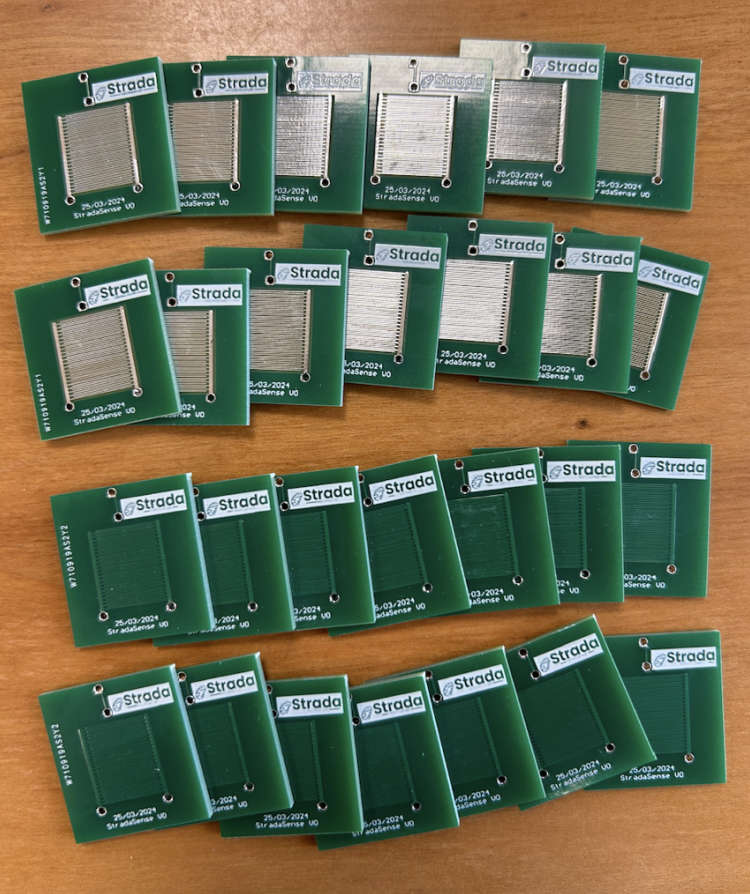
To address this, we have developed a miniaturised (2×2 cm²), low-cost, battery-free wireless sensor that can detect spoilage in real time using any standard smartphone.
The technology relies on a novel amine-responsive polymer coated onto a capacitive sensor. As protein-rich foods such as meat and poultry spoil, they release volatile biogenic amines (VBAs), which are key spoilage biomarkers. The sensor’s PSMA layer reacts chemically with these airborne molecules, altering the polymer’s electrical permittivity and causing a measurable change in capacitance.
Equipped with a standard Near-Field Communication (NFC) chip and antenna, the sensor is powered directly by a smartphone’s NFC signal, which also retrieves and transmits the capacitance data — a fully passive process unaffected by motion.
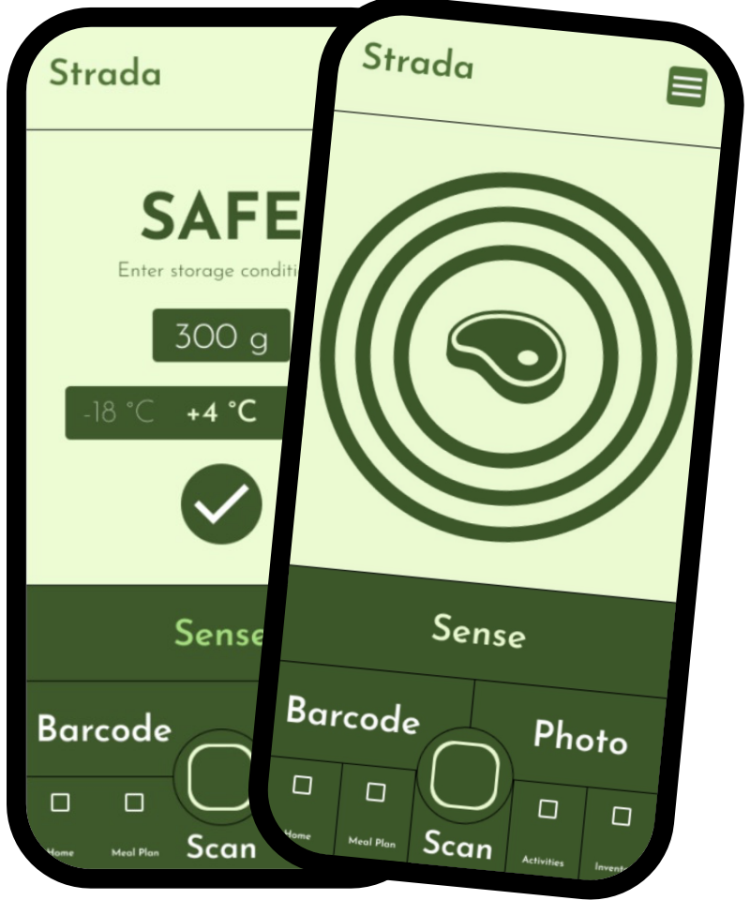
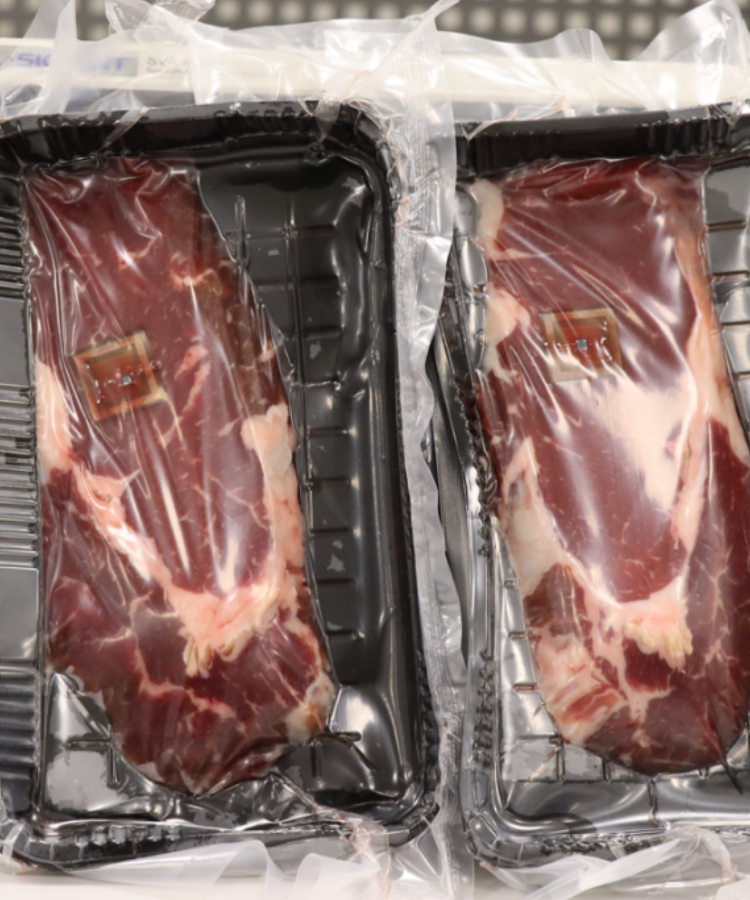
A user-friendly mobile application interprets the reading instantly and informs the user whether the food is “Fresh” or “Risky.” We have successfully demonstrated this system by embedding the sensor into packaged chicken and beef, where it accurately monitored spoilage under a range of storage conditions, from freezer temperatures to room temperature. This affordable, on-demand analysis tool can be seamlessly integrated into food packaging, empowering consumers and suppliers to make informed decisions, prevent food waste, and enhance food safety.
Users/Testers
105 users participated in the testing of the StradaApp components:
- 50 users evaluated the overall usability (including scanning, spoilage monitoring, and meal planning),
- 40 users tested the reusable polymer sensor version with chicken,
- 24 users tested spoilage detection in beef at room temperature (20°C),
- and 22 users tested spoilage detection in beef in a cool environment (4°C).
Members



Citizen Engagement
Citizen engagement was a core component of the Strada project, involving various activities from initial analysis to piloting. The engagement strategy included market analysis, co-designing the solution, piloting activities, and awareness-raising. The specific activities and the number of participants were as follows:
Market analysis and awareness: Approximately 40 people, including graduate students, researchers, and grocery store customers, participated in seminars, surveys, and polls. This helped gather data on consumer preferences, sensor interactions, and pricing models.
Co-designing the solution: Around 30 people participated in engagement meetings and demonstrations. These discussions with graduate students, research staff, and grocery store customers focused on data privacy and sensor design, informing the development of privacy features and the use of eco-friendly materials.
Piloting activities: Approximately 70 people were engaged in demonstrations at a local grocery store and a university kitchen. These activities involved consumers, graduate students, and faculty testing the sensor in real-world environments, providing feedback on usability and NFC interactions.
Data privacy and awareness raising: Around 40 people participated in webinars and training sessions on data privacy and spoilage assessment. This increased user confidence and established trust through transparency.
DataU and FOODITY components
The integration of FOODITY technologies, particularly the DataU SDK, was central to the project’s commitment to data sovereignty and user empowerment.
Value of DataU:
User control and sovereignty: DataU provides a decentralised, end-to-end encrypted platform that gives users full control over their personal information. Users can create, access, modify, or securely delete their data at any time. Feedback from 105 users confirmed they appreciated how easy it was to see and control who could access their information.
Transparency and trust: The system provides clear insights and real-time alerts on how data is being used, which users found advantageous. This transparency, along with a standardised identity verification process, builds user trust and confidence in sharing their data.
GDPR compliance: DataU ensures compliance with data protection regulations like GDPR. Testing confirmed that 100% of user requests for data deletion were processed successfully within the compliant timeframe.
Value of FOODITY Components:
Barcode scanner: This feature allows users to scan product barcodes to retrieve nutritional information from the OpenFoodFacts database. It enhances user experience by simplifying data entry and empowering users to make informed dietary choices. Testing with 83 users showed a 98% accuracy in retrieving product details.
Meal planner: This application provides personalised meal suggestions based on user preferences and the real-time freshness data from StradaSense sensors. This helps users minimise food spoilage by prioritising ingredients nearing their expiry and encourages balanced nutrition.
Results and achievements
Tangible improvements
The solution introduced several tangible improvements for users and the food system:
- Increased awareness & knowledge gain: Webinars on data privacy and spoilage assessment made participants feel "much more confident about using the system and trusting it with their information". The project actively raises awareness of the often underrecognized problem of food waste.
- Behavioural changes: The Meal Planner helps users minimise food waste by providing tailored meal suggestions that prioritise ingredients nearing spoilage. During a demonstration at a local grocery store, customers found the spoilage data "valuable for making purchasing decisions," indicating a direct influence on consumer behaviour.
- Efficiency gains: The system offers a significant improvement over traditional, lab-based food quality testing by providing real-time, actionable insights via a smartphone. This enables optimised inventory management, helping businesses avoid overstocking and reduce waste-related economic losses.
- Data use improvements: The technology generates real-time data on food freshness that was previously unavailable outside of a laboratory setting. This data supports dynamic pricing models for retailers, where prices can be adjusted based on spoilage data to mitigate food waste.
Impact Indicators
- User satisfaction scores: Usability testing with 50 users revealed a high task completion rate of 90%. The solution achieved a Net Promoter Score (NPS) of 45, indicating users are highly likely to recommend the app. The average satisfaction level across all modules was high, with StradaSense scoring 3.9 out of 5.
- Ease of use: Key metrics confirmed a highly usable interface. Users required an average of only two clicks to access spoilage data, and the average task duration was just 4.2 seconds. The error rate per task was a low 2%
The meal planner feature was designed to prioritise ingredients nearing spoilage, directly encouraging a behavioural change to reduce household food waste.
The demonstration in a local grocery store confirmed that access to real-time freshness data influenced purchasing decisions, empowering consumers to avoid potentially spoiled products.
Outputs produced
The project delivered a comprehensive food spoilage detection system comprising hardware, software, and valuable data assets.
Features developed & services launched:
- StradaSense sensor: An advanced, polymer-coated sensor module for detecting gas emissions from spoiled food. This includes a reusable version with a changeable cartridge system to enhance sustainability and cost-effectiveness. A protective cap was also developed to enhance durability in direct-contact applications involving products such as fresh meat.
- StradaApp: A mobile application that retrieves and displays real-time spoilage data from the sensors via NFC. It integrates key features like a Barcode Scanner for product information and a personalised Meal Planner.
- Web dashboard for dynamic pricing: A web-based platform was developed to display real-time measurement data and dynamically update product pricing based on freshness, providing actionable insights for retailers.
- Datasets generated: The project produced three distinct, valuable datasets, which have been uploaded to Zenodo.
- Ammonia trigger dataset: Contains sensor responses to controlled concentrations of ammonia gas, a key spoilage indicator.
- Fish spoilage dataset: Captures sensor responses to the spoilage of fish under various temperature and humidity conditions.
- Cucumber spoilage dataset: Provides sensor responses to cucumber spoilage, offering insights into the deterioration of vegetables.
Feedback from users
- Positive feedback: Users expressed confidence in the system, especially regarding DataU's data privacy measures, noting the process was "transparent and easy to follow". They found the barcode scanner “worked smoothly,” and the meal planner was effective at minimising spoilage. The hands-on demos were particularly well-received.
- Areas for improvement: Users provided valuable feedback on enhancements, including simplifying the StradaApp interface, adding more languages, improving sensor reliability, and increasing battery life. They also requested more contextual guidance, such as “consume within X days” alerts, which have been incorporated into the updated requirements.
Social/environmental/economic impact
- Economic impact: The project estimates a Return on Investment (ROI) of 180% over 3 years. The solution targets a market where it can save over $1 billion in waste-related costs. The scaling of the solution is projected to generate an estimated 12 new jobs.
- Environmental impact (FOOD 2030 Alignment): The solution directly contributes to the FOOD 2030 policy goal of advancing resource-efficient food systems. By enabling early spoilage detection, it helps reduce food waste, which in turn minimises the associated environmental footprint (e.g., wasted water, energy, and land resources) and could lead to a reduction in CO₂ emissions.
- Social impact (FOOD 2030 Alignment): The technology enhances food safety and traceability by detecting spoilage early, reducing the risk of foodborne illnesses. It fosters an innovative ecosystem by creating new business models centred on food monitoring and empowers consumers with transparent data to make healthier and more sustainable choices.
Materials and links

Alignment with FOODITY
The Strada solution aligns closely with FOODITY’s core goals of promoting data sovereignty, citizen engagement, and transparency in the food system.
Data sovereignty and transparency: The solution’s architecture is built around user control and data rights. By integrating the FOODITY DataU SDK, the platform provides a decentralised, end-to-end encrypted system where users have full control over their personal information, including the ability to create, access, modify, or delete their data at any time. This ensures GDPR compliance and provides transparency into how data is accessed and used, empowering citizens to actively manage their data rights. User feedback confirmed that the integration of DataU gave them a “sense of control” and that the consent process was transparent and easy to follow.
Citizen engagement: The project placed a strong emphasis on citizen engagement throughout its lifecycle. Activities included market analysis with ~40 participants, co-design sessions with ~30 participants, and piloting activities with ~70 people in real-world settings like grocery stores and university kitchens. This direct engagement ensured the solution was aligned with user needs, market expectations, and societal concerns from the start.
Food ethics and sustainability: The solution directly addresses the ethical issue of food waste by enabling early spoilage detection. By providing real-time data on food freshness, the system helps reduce waste at both retail and consumer levels, contributing to the FOOD 2030 goals of creating more resource-efficient and sustainable food systems.
Lessons and recommendations
Lessons learned
The development and deployment of the StradaSense system yielded several key lessons across technology, user experience, and market strategy.
Hardware and technical lessons:
- Environmental factors are critical: Testing revealed that environmental variables significantly impact sensor performance. High humidity was found to cause variability in sensor response, necessitating the development of advanced calibration protocols to account for its effects.
- Durability in real-world conditions is essential: Direct contact with fluid-rich products like fresh meat requires hardware refinement. This led to the development of a specialised protective cap and the exploration of water-repellent adhesives to prevent moisture from compromising sensor integrity.
- Reusable materials need further R&D: The reusable polymer version of the sensor showed a decline in accuracy after multiple uses, with performance dropping to 80%. This highlighted the need for additional research and development to create a more robust polymer formulation that can sustain high accuracy over repeated cycles.
User experience and software lessons
- Contextual guidance is more valuable than raw data: User feedback made it clear that simply providing spoilage data was not enough. Users needed actionable, contextual recommendations, such as "consume within X days" alerts or recipe suggestions, to help them make decisions. This led to a requirement update to add this functionality to the app.
- Hands-on, real-world demos are invaluable: Piloting activities in grocery stores and university kitchens were highly effective. These demonstrations confirmed the system's real-world applicability and provided critical feedback on NFC scanning and data presentation, insights that were more valuable than lab testing alone.
Deployment and strategy lessons
- Citizen awareness is a challenge: The project identified that a significant challenge is the general underestimation of the food waste problem among citizens. This highlights the need for continuous education and awareness-raising to drive meaningful behavioural change.
- Retail partnerships are a key to scalability: A successful demonstration at a local grocery store, where the system was well-received by both staff and customers, led to a strategic shift. The business focus evolved from an individual consumer model to prioritising partnerships with grocery stores and retail chains for initial deployment and scalability.
Deployment and strategy lessons
Based on the project’s experience, the following recommendations are offered for others developing similar solutions for food and nutrition that are respectful of data rights:
Integrate data sovereignty from the start: To build user trust and ensure regulatory compliance, integrate a robust data rights management platform like DataU from the initial design phase. Providing users with transparent control over their personal data is a foundational requirement for adoption.
Prioritise real-world piloting and co-design: Move from the lab to real-world environments like retail stores as early as possible. Engaging directly with end users through hands-on demonstrations provides invaluable feedback that cannot be replicated in a lab, helping validate and refine the solution’s practicality and user interface.
Develop for environmental robustness: Thoroughly test hardware under a wide range of real-world environmental conditions, including extreme temperatures and high humidity. Plan for physical hardware protection (e.g., protective caps) for sensors deployed in challenging settings, such as those in contact with liquids.
Provide actionable, contextual information: Design software that goes beyond presenting raw data. Users are more likely to engage with and find value in solutions that offer clear, contextual guidance and actionable recommendations (e.g., meal suggestions, “consume by” alerts) that help them make immediate decisions.
Build strategic industry partnerships for scale: For go-to-market and scalability, focus on partnering with key industry players such as food retailers, packaging companies, and technology integrators. These collaborations can facilitate joint pilot projects, co-development, and accelerated market adoption.
Main benefit of participating in the FOODITY Programme
The main benefit of participating in the FOODITY Programme was access to and integration of FOODITY’s foundational technologies, particularly the DataU SDK, the barcode scanner, and the meal planner. These pre-built, robust components were not merely features but formed a “comprehensive ecosystem” that was crucial for the project’s success.
Integrating these technologies allowed the Strada team to build a solution that was inherently secure, user-centric, and respectful of data sovereignty from the ground up. Specifically, the DataU SDK provided the essential framework for user control, transparency, and GDPR compliance, which significantly enhanced the project’s ability to deliver on its promise of putting citizens in charge of their data. This support enabled the team to focus on its core innovation — the sensor technology — while leveraging a proven platform for data management and user engagement.